The ration card rules in Andhra Pradesh come from the Andhra Pradesh Food Security Rules, 2017, which say how households are listed, who hears a complaint and by when. If a rice card is refused, a name is missing from the eligible list or the shop does not give your full quota, these rules tell you which officer must act. This is an independent site, not a government page, and what follows is a plain-language summary, not legal advice.
- What are the ration card rules in Andhra Pradesh?
- Ration card rules in AP at a glance
- Which papers make up the AP Food Security Rules 2017?
- Who counts as a household under the AP ration card rules?
- Ration card rules in AP for the eligible list: how households are listed and how to object
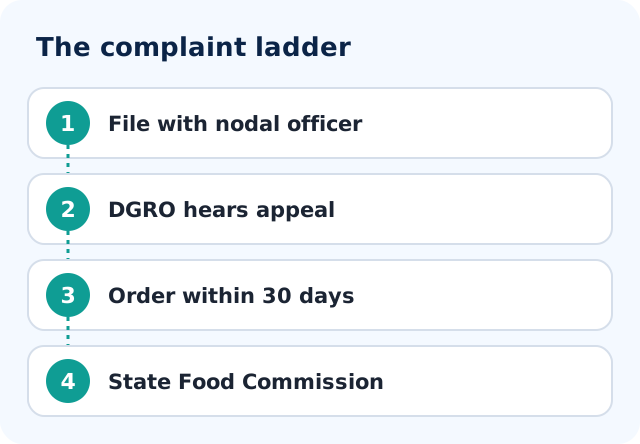
- Ration card rules and regulations in Andhra Pradesh: how the grievance ladder works
- Who is responsible for what?
- What can the DGRO order?
- Where to appeal if the DGRO's order is not acceptable
- Ration card eligibility in Andhra Pradesh: what the Rules say
- Food security allowance: when it is due
- Rice card kaise milega: AP ke niyam kya kehte hain?
- What records can the public see?
- Vigilance committees and social audit
- What do the Rules not tell you?
- Safety: keep complaints clean
- Conclusion: ration card rules in Andhra Pradesh in short
- The Rules were framed under section 40 of the National Food Security Act, 2013, and published by the state on 18 April 2017.
- They define a household, list who is excluded and who must not be left out, and require draft lists to go before the Gram Sabha or Ward Sabha, with objections disposed within 15 days.
- A complaint is to be disposed of within 15 days, with no fee. The District Grievance Redressal Officer (DGRO) hears appeals and the State Food Commission hears appeals against the DGRO.
- The Rules do not list documents or fees for card services, so use them to understand your rights, not to build a document checklist.
What are the ration card rules in Andhra Pradesh?
Every state has to turn the central Food Security Act into working rules. In Andhra Pradesh these are the Andhra Pradesh Food Security Rules, 2017, framed under section 40 of the National Food Security Act, 2013. They are the written rules behind a rice card: they define a household, say how the eligible list is drawn up and shown to the public, set a 15-day limit for a complaint, and name the officers and the State Food Commission that hear appeals. They do not list documents or fees for card services. Read them as a statement of your rights and of who is responsible, not as an application form guide.
Ration card rules in AP at a glance
| Item | Details |
|---|---|
| Name of the rules | The Andhra Pradesh Food Security Rules, 2017 (G.O.Ms.No.8, Consumer Affairs, Food and Civil Supplies Department, 18 April 2017) |
| Amendments | G.O.Ms.No.15 of 17 October 2017 and G.O.Ms.No.12 of 2 December 2019 |
| Where to read them | The department's Notices page (civilsupplies.ap.gov.in) |
| Who it is for | Rice card holders and families who want to be on the eligible list |
| Household | Nuclear family of mother, father and children; dependent parent, single woman and disabled person can be separate households (Rule 2) |
| Draft list objections | To be disposed of within 15 days of publication (Rule 3) |
| Grievance | No fee; disposal within 15 days of receipt (Rule 5) |
| Appeal | District Grievance Redressal Officer (DGRO), then the State Food Commission |
| Documents and fees for card services | Not stated in the Rules |
| Helpline | Not stated in the Rules; see our 1967 helpline guide for the number shown on the national page |
Which papers make up the AP Food Security Rules 2017?
Andhra Pradesh published the Rules through G.O.Ms.No.8 of the Consumer Affairs, Food and Civil Supplies Department, dated 18 April 2017. The Rules themselves are an annexure to that order, with eleven rules and two schedules. We downloaded and read the original rules (G.O.Ms.No.8 of 18-04-2017) and the two amendments (G.O.Ms.No.15 of 17-10-2017 and G.O.Ms.No.12 of 02-12-2019) on 20 October 2026.
On the department's Notices page we found two listings that people mix up. One row, dated 02-12-2019, is titled "The Andhra Pradesh Food Security Rules, 2017" but it is actually the amending order. The original is the row "G O Ms No 8 Dated 18-04-2017 - APS Food Security Rules, 2017". Read both together. For the Act itself, see our National Food Security Act explained guide.
Who counts as a household under the AP ration card rules?
Rule 2 defines a household as a nuclear family of mother, father and their children. Some people are treated as a separate household even if they live under the same roof or share a hearth: a dependent parent, a single woman (which includes a widow, or an abandoned, separated, divorced or unmarried woman over 35) with or without dependent children, and a disabled person with or without dependent children.
The same rule defines an "entitled person" as a member of an eligible household who holds a valid ration card. That phrase matters in a dispute, because the rights below belong to entitled persons.
Ration card rules in AP for the eligible list: how households are listed and how to object
Rule 3 sets the process. The state is to identify, using the exclusion and priority criteria, three groups: Antyodaya Anna Yojana households, priority households under the targeted public distribution system, and individuals who get supplementary nutrition and cash entitlements. The rule gave three months from publication to identify them, and 30 days to issue circulars on the processes and documentary evidence.
The steps that affect a family directly are these:
- The state may re-identify households and individuals at intervals, and may change the criteria by notification.
- It must publish the draft list of eligible and excluded households before the Gram Sabha in rural areas and Ward Sabhas in urban areas, inviting objections.
- Objections are to be enquired into and disposed of within 15 days of publication, before the final list is prepared.
- The final lists go into the public domain on a website made for the purpose, and are displayed at the Gram Panchayat or Ward Office, the Anganwadi centre and the ration shop.
The October 2017 amendment added one more item to the list of records that must be public: a list of all ration card holders, fair price shop-wise. If you want to know whether your name is on the list, these displays are your first stop. The criteria themselves are covered in our new rice card eligibility guide.

Ration card rules and regulations in Andhra Pradesh: how the grievance ladder works
Rule 5 is the part most readers need. It says anyone can record a grievance about any aspect of the Act's implementation, or about the violation or denial of a right. The original text allowed three ways: in person or by post in writing with an acknowledgement, through a web form that generates a unique complaint number, or by SMS, voice call or voice mail that also generates one. The October 2017 amendment replaced the third mode with the Meekosam portal or the State call centre.
The rule adds more protection:
- The grievance may be filed with the nodal officer directly or through a Mee-seva centre, the Act's website, the Mee-Kosam site or common complaint centre, or the designated toll-free number or call centre.
- Every receiving point keeps a register, manual or electronic, and forwards the grievance to the right nodal officer.
- A grievance not disposed of in the preset time escalates automatically to the next level.
- There is no fee for submitting a grievance.
- The authority must dispose of it within 15 days of receipt, after a hearing if needed, and communicate the decision at once and in any case within 7 days of disposal.
Who is responsible for what?
Rule 5(2) holds a table of rights, the department responsible for each, and the nodal and appellate authority. The rows that matter for ration card holders are:
- Name in the eligibility list and a ration card: the Revenue department (Tahsildar) is responsible, and the DGRO and the State Food Commission come above.
- Eldest woman as head of household: card to be issued in her name with other family members, again through the Revenue department.
- Monthly ration at the nearest ration shop during notified hours: the fair price shop dealer is responsible, with the Tahsildar and DGRO above.
- Food security allowance: where the entitled grain was not supplied because it was unavailable at the shop or for unforeseen reasons, it is to be paid by the end of the third week of the month after the month of non-supply.
The 2017 amendment re-did this table, and the copy of that amendment is a scanned image, so the column of nodal officers is hard to read cleanly. The sense I could read is that the circle Assistant Supply Officer of civil supplies became the nodal officer for ration entitlements, with the DGRO and then the State Food Commission as the appeal steps. Check the table on the official copy before quoting it to an officer. The rest of the table covers Anganwadi, school meals and maternity benefit.
What can the DGRO order?
Rule 6 names the Joint Collector-II and Additional District Magistrate of each district as the District Grievance Redressal Officer, someone not connected with delivering the entitlements. The control order of 2018 later used the title Joint Collector for the officer, so confirm the current post-holder locally.
Powers and steps in the rule:
- The DGRO receives grievances from card holders and the general public, hears them directly, or orders a preliminary enquiry by the Tahsildar or RDO.
- The DGRO has the powers of a civil court for summoning people, discovery of documents, evidence on affidavit and similar matters.
- If the complaint has no prima facie substance, it can be closed. Otherwise a notice fixes the date, time and place, there is a hearing, and the judgment must state reasons in writing.
- If the complainant does not turn up, the complaint may be decided on merits; if the other party is absent, the DGRO may proceed ex parte.
The directions can be binding. The entitlement is to be provided with immediate effect, not exceeding seven calendar days. Food security allowance must be paid by the end of the third week of the next month. The DGRO must dispose of the grievance within 15 days, and in any case within 30 calendar days of receipt at the office. Complaints are received on all working days from 10:30 am to 5:00 pm.
Where to appeal if the DGRO's order is not acceptable
Rule 6(13) says if anyone registers disagreement with the DGRO's order, the application is automatically forwarded to the State Food Commission within 7 days of the order. Rule 8(11)(b) lets the Commission hear appeals against the DGRO's decisions, and says the appeal lies within 30 days. The 2017 amendment worded the clock as 30 days from the date on which the decision should have been made by the DGRO, which covers the case where the DGRO did nothing. A complainant may also approach the Commission directly for distribution of grain, meals, cash entitlements or food security allowance if the DGRO has not redressed the complaint.
The Commission has a Chairperson, a Member-Secretary and five other members (seven in total), meets formally at least once a month, and every decision must be in writing with reasons. The 2017 amendment fixed its headquarters at Amaravati. It can summon officials and direct them to comply. The wider appeal timeline for cancelled cards sits in the 2018 order and is summarised in our AP ration card services guide.
Ration card eligibility in Andhra Pradesh: what the Rules say
Many people search for "ration card eligibility in Andhra Pradesh" or an income limit, and expect the Rules to give a number. They do not. Rule 3 only says the state will identify Antyodaya Anna Yojana households, priority households and individuals using exclusion and priority criteria, and that the state may change those criteria by notification. We did not find an income figure or a land limit in the Rules or in the two amendments. The criteria sit in separate government orders; our new rice card eligibility guide covers what we could confirm there. What the Rules do give you is the right to see the draft list, to object to it, and to have the objection decided within 15 days.
Food security allowance: when it is due
A frequent search is "food security allowance rules". Under Rule 5(2) the allowance applies where the entitled grain was not supplied because it was unavailable at the shop or for unforeseen reasons. It is to be paid by the end of the third week of the month after the month of non-supply. If a DGRO orders it, the same deadline applies. We did not find a rupee amount in the text we read, so we do not state one. If your shop gave less grain than the card allows, note the month and the quantity, file a grievance, and ask in writing whether an allowance is due.
Rice card kaise milega: AP ke niyam kya kehte hain?
In simple Hinglish: the Rules do not say "go here, bring these papers". They say the state first identifies eligible families, then shows a draft list at the Gram Sabha or Ward Sabha, and only then makes the final list. If your family should be on it and is not, file an objection within the display period, or raise a grievance if it has passed. The Rules say a woman, the eldest in the household, is to be the head of the household on the card. For the actual application steps and documents, use the department's service page and our AP ration card status check guide. Do not pay anyone who says the Rules require a fee.
What records can the public see?
Rule 7 requires the state to place records in the public domain, and it lists them: the identification guidelines, the beneficiary lists by habitation and by shop, the entitlements of grain with quantity and price, details of fair price shops, monthly shop-wise allocation orders, social audit findings and contact details of DGROs, vigilance committees and Food Commission members.
These records are open for inspection free of charge at the places in Schedule A: the Commissioner's office at state level, the District Supply Officer's office, the Tahsil or urban local body office, and the Gram Panchayat office at village level. A person gives three days' notice, may then inspect, and may request copies for the minimum copying charge used under the Right to Information Act. Copies must be given within 15 days of the application and fee.
Vigilance committees and social audit
Rule 9 renames the old Food Advisory Committees as Vigilance Committees. They supervise the schemes and must inform the DGRO in writing of any violation or malpractice. The Rules say district-level committees and below meet at least once a month. The 2018 control order, on the other hand, says every quarter, so I could not confirm which interval applies today.
Rule 10 sets up the social audit. The DGRO frames an annual calendar and announces the date at least 30 days ahead. Information is handed to facilitators at least 7 days before the Gram Sabha. Village social auditors come from entitled families but are posted in villages other than their own. The audit report is forwarded to the DGRO within a week, other complaints from it are to be resolved within 7 days, and the action-taken report is read at the start of the next Gram Sabha.
What do the Rules not tell you?
They do not give the documents for a new card, the number of days a card service takes, or any fee for it. They also do not describe e-KYC. For that, the sources are the control order and the department's service page, covered in the AP ration card status check guide. Treat any website that gives a document list as "from the Rules" with suspicion; I found none in the text.
Safety: keep complaints clean
- Use only the channels the Rules name: written complaint with an acknowledgement, the web form, Meekosam or the State call centre. Our 1967 helpline guide explains the number shown on the home page.
- Do not pay an "agent" to file a grievance. Rule 5 says no fee is charged.
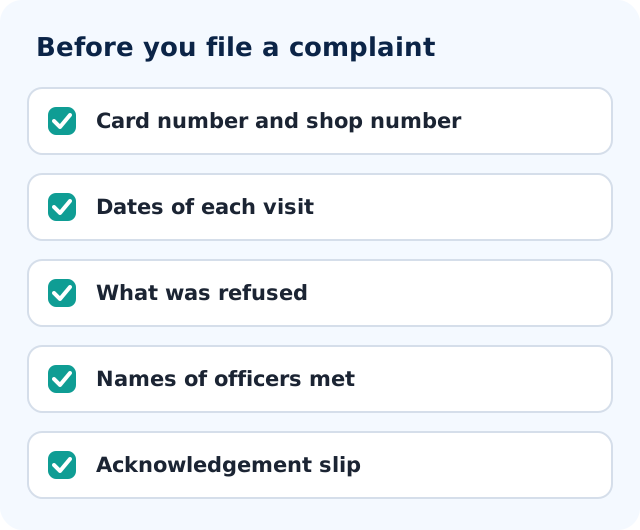
- Keep the unique complaint number. Escalation depends on a record of when you filed.
Conclusion: ration card rules in Andhra Pradesh in short
The Rules are worth reading for four things: the household definition, the public list before the Gram Sabha, a complaint answered in 15 days, and a ladder from the nodal officer to the DGRO to the State Food Commission. They are silent on forms and fees. Use them to ask the right question, and keep your paperwork. For the targeted distribution system itself, read TPDS explained.
Frequently asked questions
What are the ration card rules in Andhra Pradesh?
They are the Andhra Pradesh Food Security Rules, 2017, framed under section 40 of the National Food Security Act, 2013 and published through G.O.Ms.No.8 dated 18 April 2017. They cover the household definition, eligible lists, grievances, the State Food Commission, vigilance committees and social audit.
Do the AP rules give an income limit or a document list for a rice card?
No. Rule 3 only says the government will issue circulars about the process and the documentary evidence. We did not find an income figure or a document list in the Rules or its amendments on 20 October 2026. Check the department's current orders and service page.
How many days does a food security grievance take in AP?
Rule 5 says the concerned authority must dispose of it within 15 days of receipt and communicate the decision within 7 days of disposal. At the DGRO level the Rules say 15 days, and in any case not more than 30 calendar days. There is no fee.
Who is the DGRO for rice card complaints in AP?
Rule 6 designates the Joint Collector-II and Additional District Magistrate of the district. The 2018 control order refers to the Joint Collector for civil supplies, so confirm the current officer locally or on the department's DGRO details page.
Where can I appeal if the DGRO rejects my complaint?
To the State Food Commission. Rule 8(11)(b) says an appeal against a DGRO decision lies within 30 days, and Rule 6(13) says a disagreement registered with the DGRO is forwarded to the Commission within 7 days of the order.
Does the household definition include a widow or a single woman?
Rule 2 treats a single woman over 35, including a widow or a separated, divorced, abandoned or unmarried woman, as a separate household with or without dependent children, even when under a common roof.
Can I see the list of eligible households in my village?
The Rules require the lists to go into the public domain on a website and to be displayed at the Gram Panchayat or Ward Office, Anganwadi centre and ration shop. Records are open for inspection free of charge with three days' notice.
Rice card kaise milega, AP rules mein kya likha hai?
Rules mein sirf prakriya hai: pehle eligible families ki pehchaan, phir Gram Sabha ya Ward Sabha mein draft list, 15 din mein objection ka nipatara, phir final list. Documents aur fees Rules mein nahi hain, isliye department ka current order ya service page dekhein.