The National Food Security Act (NFSA), 2013 is the law that gives eligible families a legal right to subsidised foodgrain: 5 kg per person per month for priority households and 35 kg per household for Antyodaya (AAY) families. Your ration card carries the words "food security" because of this law, which turned subsidised grain from a government scheme into an entitlement. This page explains in plain words what the Act covers, who does what, what an NFSA ration card is, and where to complain.
- What is the National Food Security Act (NFSA kya hai)?
- National Food Security Act at a glance
- What is the National Food Security Act?
- Who is covered?
- What is each person entitled to?
- When was the National Food Security Act passed? (kab lagu hua)
- NFSA ration card: status, apply, download and KYC
- Who does what: Centre and states
- How are households chosen?
- Technology the Act has brought into ration shops
- Cash instead of grain
- Where do you complain?
- What is the 2026 amendment proposal?
- A worked example of the Act in a household
- Common misunderstandings
- Staying safe
- Conclusion
We read a Government of India factsheet hosted on static.pib.gov.in (October 2025), a notice on dfpd.gov.in, and the nfsa.gov.in and impds.nic.in home pages on 20 October 2026. We are an independent information site, not a government office, and this is not legal advice.
- The Act covers up to 75% of the rural and up to 50% of the urban population, about two-thirds of the country.
- Antyodaya Anna Yojana (AAY) households are entitled to 35 kg per household per month; priority households to 5 kg per person.
- The Centre buys and allocates grain; states identify households, issue ration cards and run the fair price shops.
- Complaints can go to the helpline 1967 or to your state's grievance system.
What is the National Food Security Act (NFSA kya hai)?
The National Food Security Act, 2013, often shortened to NFSA, is a Government of India law on food. In Hindi searches people type "National Food Security Act kya hai": it is the Act under which eligible households can buy subsidised, now free, rice, wheat or coarse grains through the ration shop, and under which pregnant women, mothers and children get meals and benefits. The Department of Food and Public Distribution describes it as ensuring access to adequate quantities of quality food at affordable prices so that people can live with dignity. The grain part works through the Targeted Public Distribution System, and states decide the household lists and issue the cards.
National Food Security Act at a glance
| Item | Details |
|---|---|
| Full name | National Food Security Act, 2013 (NFSA) |
| Official sites | dfpd.gov.in, nfsa.gov.in and impds.nic.in |
| Who is covered | Up to 75% of the rural and up to 50% of the urban population |
| Grain entitlement | AAY: 35 kg per household per month; priority households: 5 kg per person per month |
| Other benefits | Meals for children aged 6 months to 14 years, pregnant women and lactating mothers; cash maternity benefit of not less than Rs 6,000 |
| Who issues the ration card | State and Union Territory governments |
| Cost of grain | Currently free of cost by Central Government decision, extended for five years from 1 January 2024 |
| Helpline | 1967 (or 1800 plus a state-specific series), per the factsheet |
What is the National Food Security Act?
The Department of Food and Public Distribution describes it, in a notice on dfpd.gov.in, as the law through which the Government of India ensures access to adequate quantities of quality food at affordable prices, so that people can live with dignity. The factsheet adds that the Act takes a human life-cycle approach: it speaks not only to adults who need grain but also to pregnant women, mothers and children.
The Act has two pieces that matter for you. One is the grain you collect at the ration shop through the Targeted Public Distribution System (TPDS). The other is meals and benefits for mothers and children through other schemes. We take them in turn.
Who is covered?
According to the factsheet, the Act provides coverage of up to 75% of the rural population and up to 50% of the urban population. That is about two-thirds of the country. At Census 2011 population, the factsheet says this comes to 81.35 crore persons.
The key phrase is "up to". The Act sets a ceiling on coverage, and the actual list of households is made state by state. As of October 2025, the same factsheet says 78.90 crore beneficiaries were receiving free foodgrains under the Act.
The Act recognises two household categories, which our guide to ration card types covers in detail: AAY households and Priority Households.
What is each person entitled to?
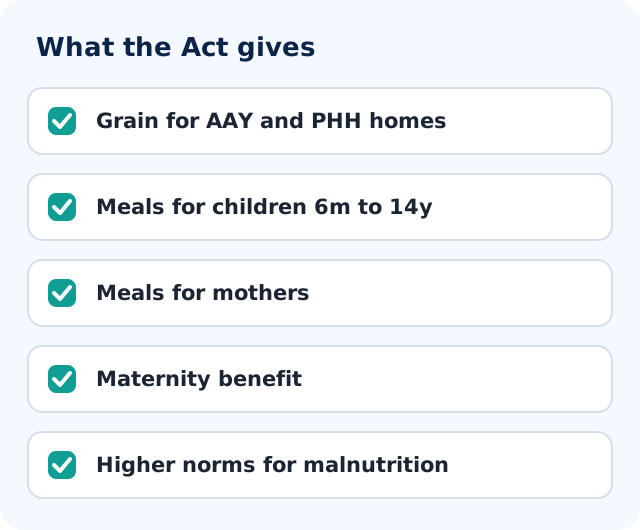
| Entitlement | Who | Quantity (as stated in the factsheet) |
|---|---|---|
| Foodgrains: rice, wheat or coarse grains | AAY households | 35 kg per household per month |
| Foodgrains: rice, wheat or coarse grains | Priority Households | 5 kg per person per month |
| Meals as per prescribed nutritional norms | Pregnant women, lactating mothers, children aged 6 months to 14 years | Through ICDS and PM-POSHAN schemes |
| Cash maternity benefit | Pregnant women and lactating mothers | Not less than Rs 6,000 |
The foodgrains are rice, wheat or coarse grains "at prices specified in Schedule-I of the Act", which is how the factsheet puts it. It also notes that these are "presently free of cost". The Centre decided to give grain free to AAY and priority households from 1 January 2023 and extended it for five years from 1 January 2024. See our explainer on PM Garib Kalyan Anna Yojana. We did not open the Act's own text to read the Schedule-I prices, so we do not quote them.
The factsheet also says higher nutritional norms are prescribed for malnourished children up to 6 years, and that the nutritional norms in Schedule-II were revised by a notification dated 25 January 2023. We did not find details of those revised norms in the pages we read, so for the exact meal specifications ask the anganwadi or school, or check the notification on the Ministry's site.
When was the National Food Security Act passed? (kab lagu hua)
Searches like "national food security act passed in which year" and "kab lagu hua" ask for a date. The Act is formally the National Food Security Act, 2013, so 2013 is its year. The pages we read for this guide (the October 2025 factsheet and the dfpd.gov.in and nfsa.gov.in pages) did not give the day it came into force in the text we could read, so we do not state a commencement date. If you need it for an exam or a legal paper, check the Act's text on the Ministry's site. What matters to a card holder is the present position: the factsheet reports 78.90 crore beneficiaries receiving free grain under the Act as of October 2025.
NFSA ration card: status, apply, download and KYC
"NFSA ration card" is how many people refer to a ration card issued to a priority or AAY household under the Act. The Act itself does not run an application, status or download page. Cards are issued by your state or Union Territory, so each of these tasks happens on the state portal. The national nfsa.gov.in site listed Foodgrains Bulletin, Fair Price Shop, Ration Cards and Allocation in its menu when we opened it, but we did not find a single national page to check a card by name. Use the state guides and the national pages below.
- Status and download: follow your state guide, for example Gujarat, Uttar Pradesh or Andhra Pradesh.
- Apply: new applications go to the state; see Telangana new ration card apply for one state's route.
- KYC and Aadhaar: the factsheet says about 99.9% of cards are seeded with Aadhaar; our ration card Aadhaar linking guide covers the steps.
Who does what: Centre and states
The factsheet is clear about the split, and it explains most disputes about "who is responsible".
The Central Government
- Procures foodgrains.
- Allocates grain to states and Union Territories.
- Arranges transport to designated depots of the Food Corporation of India (FCI).
State and Union Territory governments
- Manage allocation and distribution inside the state.
- Identify eligible beneficiaries.
- Issue ration cards.
- Supervise the fair price shops.
So if your name is missing from a card, or the shop is shut, the Centre's role is the grain and the framework; the fix is with your state or UT. This is also why card names, forms and portals differ from state to state. For example, our guide to the Telangana food security card follows one state's version.
How are households chosen?
The factsheet says the identification of NFSA beneficiaries is a continuous process under the TPDS Control Order, 2015, led by the States and Union Territories. The work includes removing ineligible, fake or duplicate ration cards so that only rightful households benefit.
AAY households are chosen by the states on the basis of Central Government criteria. Priority households are selected by the State Governments and Union Territory administrations as per their own criteria. We did not find a national rulebook for the latter, and we would rather say so than guess.
If an application for a card is turned down, the reasons are generally on the state side: see why ration card applications are rejected.
Technology the Act has brought into ration shops
The factsheet lists several reforms in the public distribution system. In its words and numbers as of October 2025:
- Ration cards and beneficiary databases are 100% digitised across all States and Union Territories.
- About 99.9% of ration cards are seeded with Aadhaar.
- About 99.6% of fair price shops (5.41 lakh out of 5.43 lakh) use e-PoS devices.
- One Nation One Ration Card is implemented across all 36 States and UTs, letting beneficiaries lift entitled grain from any fair price shop in the country. See our ONORC explainer.
- A transparency portal, an online grievance redressal facility and a toll-free number operate nationwide.
The national IMPDS portal reports these sales; see our IMPDS portal guide. The nfsa.gov.in home page menu, when we opened it, listed Foodgrains Bulletin, Fair Price Shop, Ration Cards and Allocation.
Cash instead of grain
The factsheet mentions that under the Cash Transfer of Food Subsidy Rule, 2015, notified in August 2015, states can opt in to move away from grain distribution in identified areas, with written state consent. It says Chandigarh and Puducherry (from September 2015) and part of Dadra and Nagar Haveli and Daman and Diu (from March 2016) have the Act operating in cash-transfer mode, where the subsidy goes to the beneficiary's bank account. Elsewhere, traditional grain distribution continues.
Where do you complain?
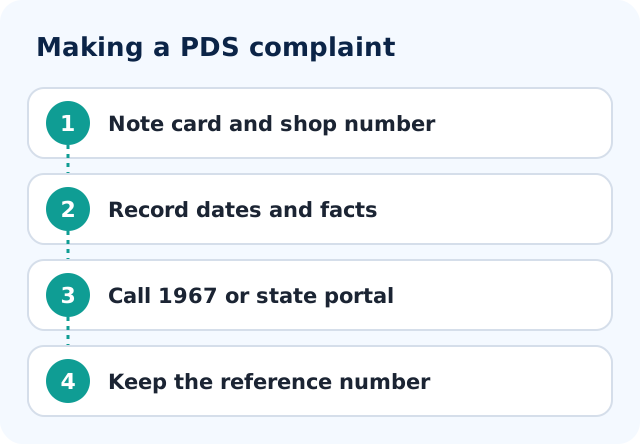
The factsheet states that the helpline number 1967 (or 1800 plus a state-specific series) is operational in all States and UTs for complaints about the public distribution system, including corruption and embezzlement. The same line is printed on the dfpd.gov.in home page. It also says complaints received by the Department are forwarded to the State or UT concerned for inquiry and appropriate action.
This tells you how to use the channel: the helpline records your complaint, and the state acts on it. Keep the details ready.
- Your ration card number and the shop number.
- Date and time of each visit.
- What was refused or short, and by how much.
- Any slip, message or photo.
We did not find the Act's statutory complaint structure (for example officers or commissions at district and state level) described on the pages we could read, so we do not describe it here. Ask your state civil supplies department which officer handles grievances in your district. For one state's channel in full, see the Telangana civil supplies grievance guide.
What is the 2026 amendment proposal?
A notice on dfpd.gov.in invited public comments, by 13 July 2026, on a draft National Food Security (Amendment) Bill, 2026. The notice states that AAY households are legally entitled to 35 kg per family per month, while priority households get 5 kg per person. It says the household-based AAY quantity creates unequal per-person entitlements depending on household size.
The draft proposes that every person in an AAY household be entitled to 7 kg of foodgrains per person per month, while AAY households would be entitled to a maximum of 35 kg per household per month. It is a draft Bill released for consultation. We did not confirm on 20 October 2026 that Parliament has passed it, so until an official notification appears, the existing 35 kg per household stands.
A worked example of the Act in a household
Take an imaginary priority household of five: two adults, two school-age children and a grandmother. Using only the official figures, the household is entitled to 5 x 5 = 25 kg of foodgrains a month. If the household has a pregnant woman, the Act separately provides meals through ICDS and a cash maternity benefit of not less than Rs 6,000, according to the factsheet. The two school-age children are in the 6 months to 14 years age group, so they are entitled to meals as per nutritional norms through PM-POSHAN and ICDS, as the factsheet describes.
Now change one detail: the same family lives in an AAY household. The grain entitlement becomes 35 kg for the household, whatever its size. That is the situation the 2026 draft amendment wants to make fairer. The example is illustrative; whether a real family is AAY or priority is decided by its state.
The lesson is that the Act is not one benefit but a bundle: grain through the ration shop, meals through anganwadi and school, and a maternity benefit. Many families use the first and forget the others. Ask your local anganwadi or school what is available to you, since we did not read the operating details of those schemes.
Common misunderstandings
"The Act gives every citizen ration"
No. It covers up to 75% of rural and 50% of urban people, and the households are identified by the states.
"The Centre issues the ration card"
No. The factsheet says the State and UT governments issue ration cards.
"Free ration is a separate law"
Free supply is a decision by the Central Government on the price of the grain under the Act, extended for five years from 1 January 2024 according to the factsheet.
"The Act only covers grain"
No. It also provides meals and a cash maternity benefit through other schemes.
Staying safe
- No official will charge to "put you under the Food Security Act". Do not pay agents.
- Do not give your Aadhaar number or OTP to an unknown caller offering to update your card.
- Open only gov.in or nic.in portals, typed by yourself.
- Forwarded messages about new "Food Security schemes" should be checked on dfpd.gov.in or nfsa.gov.in first.
Conclusion
The Act has three simple takeaways: it covers a large but limited share of the population, it sets a per-person or per-household grain entitlement, and the states run the machinery that delivers it. Know your card type, know your member count and know the helpline. Sources opened on 20 October 2026: the static.pib.gov.in factsheet "Securing Every Plate" (October 2025), dfpd.gov.in, nfsa.gov.in and impds.nic.in.
Frequently asked questions
What is the National Food Security Act, 2013?
It is the law under which eligible households have a legal entitlement to subsidised foodgrains through the Targeted Public Distribution System, and under which mothers and children get meals and benefits through other schemes. National Food Security Act kya hai: a food-rights law of the Government of India.
In which year was the National Food Security Act passed?
The Act is the National Food Security Act, 2013. The pages we read did not give the day it came into force, so we do not state one. Check the Act's text on the Ministry's site if you need the exact date. National Food Security Act kab lagu hua is answered the same way.
What is an NFSA ration card?
It is the ration card of a household identified under the Act, either as AAY or priority. The card is issued by your state or Union Territory government, not the Centre. The Act does not give a national page to check or download it.
Who is eligible under NFSA?
Coverage is up to 75% of the rural and up to 50% of the urban population. AAY households are chosen on Central Government criteria and priority households on each state's own criteria, so ask your state civil supplies department.
How much grain does a family get under NFSA?
According to the factsheet we read, AAY households get 35 kg per household per month and priority households get 5 kg per person per month. The grain is currently supplied free of cost by decision of the Central Government.
How do I check NFSA ration card status or apply for one?
Use your state's food and civil supplies portal, since states issue and track cards. We did not find a national page that checks status by name. Our state guides explain the steps, and this site never asks for your Aadhaar number or OTP.
Does the Act cover children and pregnant women?
Yes. The factsheet says pregnant women, lactating mothers and children aged 6 months to 14 years are entitled to meals under ICDS and PM-POSHAN, and that pregnant women and lactating mothers get a cash maternity benefit of not less than Rs 6,000.
Where can I complain about NFSA ration?
Call 1967, the helpline printed on the dfpd.gov.in home page and named in the factsheet as operational in all States and UTs, or use your state's grievance system. Note your card number, shop number and dates first.