TPDS stands for Targeted Public Distribution System, the system that delivers subsidised grain from government stores to ration card holders through fair price shops. It was launched in June 1997 to focus the older public distribution system on the poor, and the National Food Security Act now tells it whom to serve. This page explains the full form, the PDS vs TPDS difference, who does what and how the system changed from the 1960s to today.
- What is TPDS?
- TPDS at a glance
- Difference between PDS and TPDS
- Who does what?
- When TPDS started, and a short history in five stops
- The BPL and APL years
- What the National Food Security Act changed
- TPDS Control Order 2015: what the official pages say
- Who issues ration cards under TPDS, and who picks the households?
- The digital layer on top of the system
- Where you can see official data
- A proposed change to know about
- Common misunderstandings
- Safety
- Conclusion
- The public distribution system (PDS) is run jointly by the Centre and the States/UTs; TPDS, started in June 1997, aimed it at the poor.
- The Centre buys, stores, moves and allocates grain in bulk through the Food Corporation of India; states choose households, issue ration cards and supervise fair price shops.
- Since the National Food Security Act, 2013, PDS is governed by the Act and coverage no longer depends on old poverty estimates.
- Under the Act, AAY households get 35 kg per household per month and priority households 5 kg per person per month.
What is TPDS?
TPDS is the Targeted Public Distribution System, the part of India's food policy that sells or gives foodgrains at low or no cost to eligible households through a network of fair price shops (ration shops). "Targeted" means the benefit is meant for identified households, not for everyone. The Centre buys, stores and moves the grain; the State or UT government chooses the households, issues the ration cards and supervises the shops. In Hindi and Hinglish people ask "TPDS kya hai" or "TPDS ka full form": the answer is Targeted Public Distribution System, in Hindi लक्षित सार्वजनिक वितरण प्रणाली. All facts here come from the National Food Security Act portal (nfsa.gov.in) and PIB pages opened on 20 October 2026. fsccardsearch.in is an independent site and not a government office.
TPDS at a glance
| Item | Details |
|---|---|
| Full form | Targeted Public Distribution System |
| Launched | June 1997, "with focus on the poor" (NFSA portal) |
| Run by | Joint responsibility of the Central and State/UT Governments |
| Centre's job | Procurement, storage, transport and bulk allocation, through the Food Corporation of India |
| State's job | Identify households, issue ration cards, license and supervise fair price shops, handle grievances |
| Current law | National Food Security Act, 2013 (AAY and priority households) |
| Official portals | nfsa.gov.in and dfpd.gov.in |
| Cost to the beneficiary | Grain has been free for AAY and priority households since 1 January 2023, per PIB; extended for five years from 1 January 2024 |
| Helpline | 1967 / 1800-State series (see our ration card helpline page) |
Difference between PDS and TPDS
The NFSA portal's page on the Public Distribution System says PDS "evolved as a system of management of scarcity". Over the years it became an important part of the government's food policy. The page also says PDS is "supplemental in nature" and is not meant to supply a household's entire need of any commodity.
TPDS is the same network with a sharper aim. The portal says the Government launched the Targeted Public Distribution System in June 1997 "with focus on the poor". Before that, the ration shop served many people at one price. After it, who you were and what category you held decided what you paid and how much you got. The ration card became a document of category.
Who does what?
The portal states that PDS "is operated under the joint responsibility of the Central and the State/UT Governments". The split is clear in official wording.
| Level | Main jobs |
|---|---|
| Centre, through the Food Corporation of India | Procurement, storage, transportation and bulk allocation of foodgrains to the States |
| State / UT government | Allocation within the state, identification of eligible families, issue of ration cards, supervision of fair price shops |
| Fair price shop dealer | Hands out the entitled foodgrains to card holders (licensed and monitored by the State) |
The NFSA portal's page on the Act adds that States and UTs also issue licences to fair price shop dealers and monitor them, and that they must set up grievance redressal. A PIB backgrounder of 15 October 2025 says the Centre moves grain to designated depots of the Food Corporation of India, and that states manage intra-state allocation and distribution.
What does that mean for you? Questions about your card, your shop or your category go to the state food department, not to the Centre. Our ration card types guide shows how categories are labelled.
What is actually distributed?
The portal says that under PDS the commodities "presently" allocated to States/UTs are wheat, rice, sugar and kerosene. It adds that some states also distribute extra items of mass consumption through PDS outlets, such as pulses, edible oils, iodised salt and spices. So the list at your own shop depends on your state. Under the Act the entitlement we usually talk about is foodgrains.
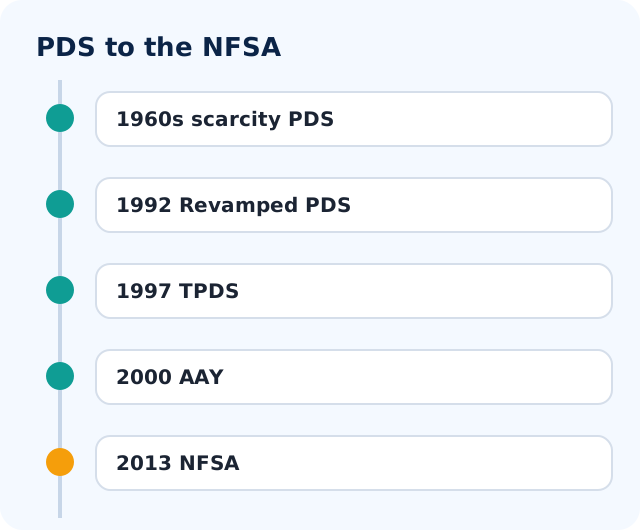
When TPDS started, and a short history in five stops
- Before the 1960s and in the 1960s. The portal says public distribution existed in the inter-war period, and the PDS with a focus on food-short urban areas "emanated from the critical food shortages of 1960s".
- 1970s and 1980s. The reach of PDS was extended to tribal blocks and areas with a high incidence of poverty.
- June 1992: Revamped PDS. Launched to strengthen the system in remote, hilly and hard-to-reach places, covering 1,775 blocks, with a scale of issue of up to 20 kg per card.
- June 1997: TPDS. A focus on the poor. The portal says it was meant to benefit about 6 crore poor families, with about 72 lakh tonnes of grain earmarked a year. States identified the poor using the Planning Commission's 1993-94 poverty estimates.
- 2013: the Act. The National Food Security Act, enacted on 5 July 2013, made food a legal entitlement.
The BPL and APL years
Under the 1997 design, families were grouped as below the poverty line (BPL) or above it (APL). The NFSA portal records some of the numbers. From 1 April 2000, the Centre raised the allocation to BPL families from 10 kg to 20 kg of foodgrains per family per month at 50 percent of economic cost, and set APL issue prices at 100 percent of economic cost, so that the consumer subsidy could go to the BPL population. The number of BPL families was revised to 652.03 lakh, against 596.23 lakh originally estimated. Since 2001, the portal says, states have had the freedom to fix retail issue prices, no longer bound to stay within 50 paise per kg over the central price.
In December 2000 the government added the Antyodaya Anna Yojana for the poorest. We explain it in a separate page on Antyodaya Anna Yojana.
These categories are history now for many cards, but you may still hear people say "BPL card" or "APL card". Under the Act the two groups in the official wording are AAY and priority households.
What the National Food Security Act changed
The NFSA portal's "Salient Features" page lists the shift. Among its points:
- PDS is now governed by the Act, and coverage is "de-linked from the erstwhile poverty estimates".
- Coverage is 75 percent of the rural and 50 percent of the urban population, nearly two-thirds of the country, as per Census 2011 estimates, with state-wise coverage set by the erstwhile Planning Commission (now NITI Aayog) using a 2011-12 consumption survey.
- Two categories: Antyodaya Anna Yojana households and priority households.
- 35 kg per AAY household per month, and 5 kg per person per month for priority households.
- The eldest woman of the household aged 18 or above is treated as head of family for issuing ration cards.
- Grievance redressal through State Food Commissions, DGROs and vigilance committees, and provisions to put records and beneficiary lists in the public domain.
The Act's central issue prices were Re 1, Rs 2 and Rs 3 per kg for coarse grain, wheat and rice, kept unchanged till June 2019, according to the portal. Today the picture is different: the PIB backgrounder says the Centre decided to give foodgrains free to AAY and priority households from 1 January 2023, and extended the free distribution for five years from 1 January 2024. See our PM Garib Kalyan Anna Yojana page.
For the Act itself and its other provisions, read our National Food Security Act explained page.
TPDS Control Order 2015: what the official pages say
People search "TPDS Control Order 2015" and "TPDS Control Order 2015 pdf". The only description we rely on is the PIB backgrounder of 15 October 2025, which says that under the TPDS (Control) Order, 2015, identification of NFSA beneficiaries is a continuous process led by States and UTs, including removing ineligible, fake or duplicate cards. We have not read the Order itself, so we do not quote its clauses. For the full text, use dfpd.gov.in.
Who issues ration cards under TPDS, and who picks the households?
The portal explains that within each state's fixed coverage, identification of eligible households is done by the State or UT. For AAY they follow the scheme's guidelines. For priority households each state evolves its own criteria. The PIB backgrounder adds that, under the TPDS Control Order, 2015, identification is a continuous process led by states, which includes removing ineligible, fake or duplicate cards. The portal's salient-features page also says exclusions can follow death or migration and inclusions can follow births or the discovery of genuinely left-out households.
This is why a card can be removed, why a new card application can be rejected, and why the details vary from state to state. Our article on ration card rejected reasons looks at the common causes.
The digital layer on top of the system
PIB's October 2025 backgrounder reports these national figures:
- 100 percent digitisation of ration card and beneficiary databases.
- About 99.9 percent of ration cards seeded with Aadhaar.
- About 99.6 percent of fair price shops (5.41 lakh of 5.43 lakh) automated with ePoS devices.
- Supply chain management computerised in 31 States/UTs.
- One Nation One Ration Card operational in all 36 States/UTs.
Those reforms sit on top of the old structure, not in place of it. You still need a card issued by a state, a shop licensed by a state and an entitlement that is set by the Act. If you want the shop-counter side of it, read about the ePoS device at the fair price shop, and for moving between states, One Nation One Ration Card.

Where you can see official data
You can check the system's own numbers rather than rely on rumours. When we opened the NFSA portal home page on 20 October 2026, its menu included sections for Fair Price Shops, Total FPSs and Operational e-PoS, Ration Cards, Ration Card Details on State Portals, Allocation, and monthly Foodgrains Bulletins, with issues listed from April to August 2026. The portal also keeps a list of State Food Portals. These are the places to look when you want to know how many shops in a state have working devices, or how many ration cards a state reports. They show system-wide counts, not your personal card, so for that you need your state's own search page.
A proposed change to know about
The Department of Food and Public Distribution published a draft National Food Security (Amendment) Bill, 2026 for comments until 13 July 2026. It proposes to move AAY households from 35 kg per household to 7 kg per person with a cap of 35 kg per household. When we checked on 20 October 2026, we did not find an official notice that it had become law. We explain the draft in the AAY page.
Common misunderstandings
- "The Centre issues ration cards." No. The portal says States and UTs issue them.
- "PDS covers everything I eat." The portal says it is supplemental, not meant to meet the whole requirement.
- "APL and BPL are the categories under the Act." They belong to the earlier system. The Act speaks of AAY and priority households.
- "Free grain means the system has ended." Free grain is the price. The card, shop and entitlement structure still applies.
- "A rule I saw online applies in my state." Item lists, forms and criteria vary by state, so check your state's food department.
Safety
- No official will issue or "upgrade" a card for a fee. If someone asks for money, step back.
- Do not send your Aadhaar number or OTP to a stranger claiming to update your TPDS record.
- Check scheme changes on dfpd.gov.in and nfsa.gov.in, not on forwarded messages.
- For shop problems, see our ration card helpline guide.
Conclusion
TPDS is easiest to understand as a relay. The Centre buys and moves grain, the state picks families and licenses shops, and the shop gives you your share. From 1997 it narrowed its focus to the poor, and from 2013 the National Food Security Act wrote the entitlement into law, with AAY and priority categories replacing the older BPL and APL labels in the official language. For anything personal, from correction to complaint, begin with your state food department. For the big picture, nfsa.gov.in and dfpd.gov.in are the pages to trust.
Frequently asked questions
What is the full form of TPDS?
TPDS stands for Targeted Public Distribution System. The NFSA portal says it was launched in June 1997 with a focus on the poor. It works through the same network of fair price shops as the wider public distribution system.
TPDS kya hai aur TPDS ka full form kya hai?
TPDS ka full form Targeted Public Distribution System hai, yaani lakshit saarvajanik vitaran pranali. Ye ration dukaan ke zariye gareeb parivaron tak anaaj pahunchane ki vyavastha hai, jo June 1997 me shuru hui thi.
What is the difference between PDS and TPDS?
PDS is the broad system of distributing food at affordable prices, which the NFSA portal says evolved as a way to manage scarcity. TPDS is the 1997 version aimed at the poor. Today it is governed by the National Food Security Act, 2013.
In which year did TPDS start?
The NFSA portal says the Government launched the Targeted Public Distribution System in June 1997. It followed the Revamped PDS of June 1992, and the Antyodaya Anna Yojana was added in December 2000.
What is the TPDS Control Order, 2015?
A PIB backgrounder says that under it, identification of NFSA beneficiaries is a continuous process led by States and UTs, including removing ineligible, fake or duplicate cards. We have not read the Order itself, so use the department site for its full text.
Who issues ration cards, the Centre or the State?
The State or UT. The NFSA portal lists issuing ration cards, identifying eligible households, distributing grain through fair price shops and licensing dealers among the responsibilities of the States and UTs. The Centre handles procurement, storage, transport and bulk allocation.
Are APL and BPL cards still used under TPDS?
Those labels come from the earlier TPDS design. The Act's official categories are Antyodaya Anna Yojana (35 kg per household per month) and priority households (5 kg per person per month). Some people still use the old names, so ask your food department what your card means.
Can fsccardsearch.in change my TPDS details?
No. We are an independent information website with no link to any government department. We cannot add, remove or change anything on a ration card, and we never ask for your Aadhaar number or OTP.