Gujarat ration card status is checked by finding your family in the beneficiary list on the IPDS Gujarat pages, or by following up an application with the acknowledgement from Digital Gujarat or the Mamlatdar office. Gujarat does not work like a single login portal: different pages handle the card list, the application, the shop locator and the complaint. This guide connects them, explains the card groups used in Gujarat, and shows how to add a name, fix an error, or follow up when nothing seems to move.
- What is a Gujarat ration card status check?
- Gujarat ration card status at a glance
- Gujarat ration cards in plain words
- The websites you actually need
- How to check Gujarat ration card status and the village-wise list
- Applying for a new ration card in Gujarat
- Gujarat ration card details and download
- Who is eligible for a ration card in Gujarat?
- Gujarat ration card kaise banaye (how to make one)
- Gujarat ration card e-KYC status and helpline
- Services available for an existing card
- Adding a name to the Gujarat ration card
- e-KYC and the barcoded ration card
- How the fair price shop works in Gujarat
- Mamlatdar, e-Gram and the local counter
- Complaints and grievances
- Where Gujarat families lose time
- Before you trust a message about your Gujarat card
- What to remember about Gujarat's system
- There is no single "status" box; check your name in the IPDS ration card abstract list by month, district, taluka and shop.
- New cards and changes are applied for through Digital Gujarat or the Mamlatdar office, e-Gram centre or Jan Seva Kendra.
- Directorate main page number: 079-23251170; Digital Gujarat help desk on district pages: 1800 233 5500. Both may be old, so confirm.
- We did not find an official page to download a ration card by number.
This page is an independent explainer rather than an official Gujarat government notice. Applications are not accepted here, and you should never send us an Aadhaar number, OTP or card photo.
What is a Gujarat ration card status check?
A Gujarat ration card status check means confirming two things: whether your family is shown as an active card holder in the state's beneficiary list, and what has happened to any request you made, such as a new card, a name addition or a correction. The first is done on the IPDS Gujarat ration card abstract list, which shows families by month, region and fair price shop. The second is tracked through the acknowledgement you received when you applied. The cards are issued and managed by the Food, Civil Supplies and Consumer Affairs Department through district supply offices and taluka Mamlatdar offices. Searches such as "Gujarat ration card details", "online check" and "Digital Gujarat ration card status check" all come back to these two routes.
Gujarat ration card status at a glance
| Item | Details |
|---|---|
| Official sites | dcs-dof.gujarat.gov.in, ipds.gujarat.gov.in, digitalgujarat.gov.in |
| Who it is for | Ration card holders and applicants in Gujarat (NFSA and non-NFSA families) |
| What you need for the list | Month and year, district, taluka, village or shop, then your card number or head of family name |
| What you need to apply | Aadhaar of members, address proof, photographs; income proof where required (details on the portal) |
| Cost | Not stated on the official pages we read |
| Helpline | 079-23251170 (directorate main page); 1800 233 5500 (Digital Gujarat help desk on district pages) |
| What you get | Confirmation of your name in the list and the shop it is attached to |
Gujarat ration cards in plain words
In Gujarati the card is ration card or rashan card, and the shop is commonly called sasta anaj ni dukan (cheap grain shop) or fair price shop. The cards are issued and managed by the Food, Civil Supplies and Consumer Affairs Department through the district supply offices and the taluka Mamlatdar offices.
Gujarat has two broad groups of families:
- NFSA families: households covered under the National Food Security Act, which includes Antyodaya (AAY) families and priority households, described as NFSA priority households.
- Non-NFSA families: households with APL type cards that are not in the NFSA list. Their entitlement is decided by state orders.
Public data websites publish district-wise counts of cards under AAY, BPL and APL groups, but those are aggregate figures, not a way to check your own card. Entitlements such as kilograms per person change by order, so the safe approach is to confirm at your shop how much is issued this month.
| Group | Meaning | Where to confirm |
|---|---|---|
| AAY | Poorest households, higher family entitlement | Mamlatdar or supply office |
| NFSA priority / BPL type | Households selected under NFSA norms | Card abstract list, shop |
| APL / non-NFSA | Households outside the NFSA list | State orders and shop notice |
The websites you actually need
Gujarat spreads its ration card information over a few official sites. Know which one does what:
- dcs-dof.gujarat.gov.in is the directorate's site. It carries the public distribution section (NFSA, state schemes, ration card, fair price shop, LPG), an e-Citizen menu with the online complaint link and an e-KYC section, a transparency portal and a "Know your FPS" locator.
- The IPDS Gujarat portal, ipds.gujarat.gov.in (the directorate site links to it), hosts the ration card abstract and social audit pages, where beneficiary lists by month and region can be viewed.
- Digital Gujarat is the citizen service portal where district pages say ration card services such as new card, separate card and name addition are applied for.
The directorate's main page lists only a head office number, 079-23251170, and an email address. The Digital Gujarat help desk number shown on district pages is 1800 233 5500. These pages can be old, so confirm numbers on the site you are using.
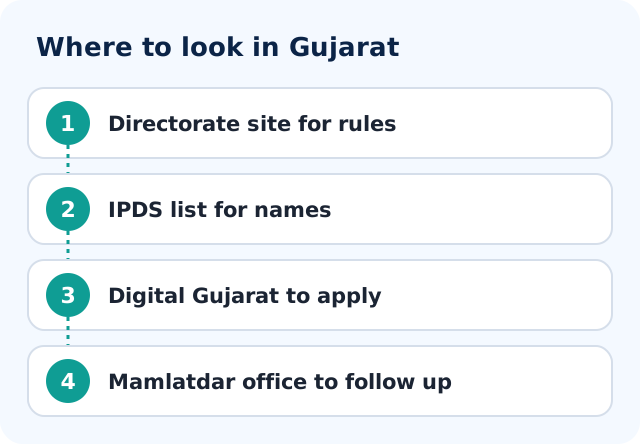
How to check Gujarat ration card status and the village-wise list
Because there is no single "ration card status" box, the practical way to check is the beneficiary abstract list. Search phrases such as "Gujarat ration card list by village" and "ration card name search" lead here.
- Open the IPDS ration card abstract page from the official Gujarat PDS pages.
- Choose the month and year, and enter the captcha if asked.
- Click Go. The page lists regions, so pick your district and taluka.
- Select the village, ward or fair price shop shown in the list.
- Look for your ration card number or head of family name. Click the card number to see members.
The lists are shown by shop and region and may be in Gujarati and English. If you cannot find a family name, spelling differences are the most common cause; check the Gujarati spelling and the shop number. A village-wise list is also mentioned for the directorate site, and guides say that families can use it to see whether APL, BPL, NFSA or non-NFSA families are shown. If the page layout has changed, look for the closest label.
If the name is not on the list
Do not assume the card has been cancelled. It may be in a different taluka, or a name may have been added after the list month. Check the next month, then ask your fair price shop owner and the supply clerk at the Mamlatdar office. People whose names are really missing can apply on the prescribed form for inclusion; the department decides eligibility.
Applying for a new ration card in Gujarat
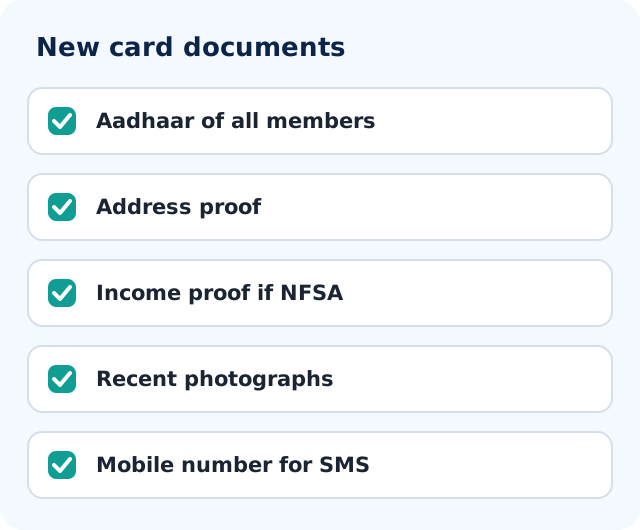
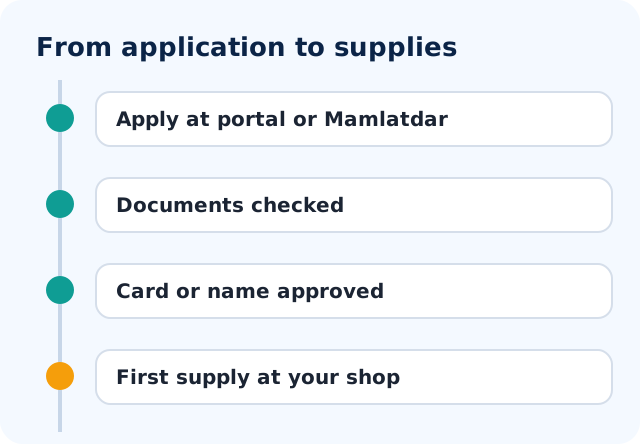
The directorate site has a page on how to obtain a new ration card, and also describes the barcoded ration card. District pages on Digital Gujarat say that applications are made through the Digital Gujarat portal or at the Mamlatdar office, e-Gram centres and Jan Seva Kendras. The usual online route, as described by guides, is: log in or register as a citizen on Digital Gujarat, open the citizen services and the ration card service, fill in the form, upload documents and submit.
Documents commonly needed
- Aadhaar of the head of family and members
- Proof of residence such as electricity bill or rent agreement
- Income proof or declaration where required for NFSA claims
- Photographs of the applicant
- Proof of separation if you want a separate card from the parents' card
Income limits apply for BPL-type and NFSA claims; confirm them with the supply office, because blogs quote different figures and the state selection norms can change.
Gujarat ration card details and download
For "Gujarat ration card details", the abstract list is the place: click your card number and the members of the family are shown. We did not find an official page where a card can be downloaded as a PDF by entering a number, so be careful with websites that promise one. If you need a copy, take a screenshot of the details page for your own record, or ask the Mamlatdar office. A lost or damaged card is replaced through the duplicate ration card service listed in the table below.
Who is eligible for a ration card in Gujarat?
Eligibility is decided by the department, not by this site. Households covered under the National Food Security Act, including Antyodaya and priority families, hold NFSA cards; APL families outside that list hold non-NFSA cards. Income limits apply for BPL-type and NFSA claims, but blogs quote different figures and the state's selection norms can change, so we do not print a number. Ask the supply office for the current norms. The national background is in our National Food Security Act guide.
Gujarat ration card kaise banaye (how to make one)
Hinglish searchers ask "Gujarat ration card kaise banaye". The route is the one described in the section on applying for a new card: register on Digital Gujarat or visit the Mamlatdar office, e-Gram centre or Jan Seva Kendra, submit the form with Aadhaar, address proof and photographs, and keep the acknowledgement. Do not pay an agent, and confirm the form and any fee on the service page.
Gujarat ration card e-KYC status and helpline
We did not find a page where e-KYC status can be checked by card number. The e-KYC process is done at the shop on the e-PoS device, so ask the shop owner what the system shows for your family. For help, the directorate main page lists 079-23251170, and district pages show 1800 233 5500 for Digital Gujarat queries. Confirm both on the official site before calling.
Services available for an existing card
District service pages list a set of ration card services offered by Mamlatdar offices:
| Service | When you need it |
|---|---|
| Add a name | Birth, marriage, return to family |
| Remove a name | Death, marriage out, shifted family |
| Change or correction in details | Wrong spelling, age, relation |
| Separate ration card | Family split into a new household |
| Duplicate ration card | Lost or damaged card |
| Transfer to another taluka or district | Permanent shifting |
| Cancel the card | Moved out of state or surrender |
One district page says applications are made through Digital Gujarat, with the physical location being the Mamlatdar offices. That page was last updated years ago and does not list documents or fees, so use it only as a pointer. Fees, forms and timelines should be read from the service page on the portal. For the common reasons behind refusals, see our rejection reasons and reapply guide.
Adding a name to the Gujarat ration card
For a newborn, take the birth certificate and the parents' card. For a bride, take the marriage certificate and a deletion certificate from her parents' card, since the same person should not appear in two NFSA cards. For a member returning to the family, take Aadhaar and address proof. Submit at the Jan Seva Kendra or Mamlatdar office, or on the portal if the service is open for online submission, and keep the acknowledgement. Because duplicate entries are a leading cause of delays, remove the name from the old card if a person has moved.
Spelling and Aadhaar mismatch
If your name is spelled differently on the ration card and Aadhaar, seeding may fail and e-KYC may not match. The cleaner fix is to correct the card using the change in details service, bringing a school certificate or other proof. Our Aadhaar linking guide explains the general seeding process.
e-KYC and the barcoded ration card
The directorate's e-Citizen menu has an e-KYC section. Across India the usual pattern is that the shop owner starts e-KYC on the e-PoS device and each cardholder completes biometric authentication. Aadhaar-based verification of NFSA beneficiaries has been asked of all states, but Gujarat follows its own timetable. We could not find a current Gujarat notice with a last date, so check with your fair price shop or the district supply office.
Gujarat has also introduced the barcoded ration card (BRC). The directorate page lists it as information only, without application steps. If you get a new type of card, keep the old one until the shop has confirmed the new one is active in the system.
How the fair price shop works in Gujarat
The directorate's website has a "Know your FPS" option and a "What do I get" section tied to the fair price shop information. Gujarat's NFSA families collect grain on monthly distribution days. The e-PoS machine at the shop identifies the cardholder by Aadhaar fingerprint or by another approved method, and the bill is generated from the database.
Other items on the directorate page show what the department runs besides wheat and rice: the double fortified salt scheme, the public distribution of pulses scheme (chickpea), and national programmes such as the Pradhan Mantri Garib Kalyan Anna Yojana and Ujjwala for LPG. The availability of each item changes by period. Read the shop notice board and ask for a receipt. The national portability system also lets migrant workers collect grain elsewhere; see One Nation One Ration Card. For neighbouring states, our Rajasthan and Maharashtra guides describe their own portals.
Gujarat's monthly cycle at the shop
In Gujarat the shop works to a fixed monthly schedule, and the distribution days for your shop are put up on its notice board. Because the stock for a month comes in against the number of cards attached to that shop, a card that is not showing correctly on ipds.gujarat.gov.in for the month can mean the shop owner has no entitlement to issue against it. That is why it is worth checking the abstract list for the current month at the start of the month rather than on the last day.
Newer barcoded cards are meant to make the match between card and shop record quicker, since the card number can be read from the code instead of keyed in by hand. If your card is the older paper type, carry the number written separately in case the booklet is damaged. After you buy, check the printed or displayed bill against the weight in your bag, and keep the bill if you are asked to show it at the Mamlatdar office later.
Mamlatdar, e-Gram and the local counter
In Gujarat the Mamlatdar office at the taluka headquarters is the place where most ration card work is finally decided, even when you apply on Digital Gujarat. Rural families often start at the village e-Gram centre, which acts as the nearest assisted counter, and urban families use the Jan Seva Kendra of their ward or zone. The supply clerk at the Mamlatdar office is the person who can tell you whether your file is waiting for verification, waiting for a document, or already approved and only awaiting the next month's list update.
When you visit, carry the acknowledgement printout and the originals of the certificates, and ask the clerk to note the date of your visit on your copy. If you are told to come back, ask what exactly is pending. A specific answer, such as a missing deletion certificate for a bride, is something you can fix in one trip, while a vague answer is a reason to ask for the reply in writing.
Complaints and grievances
Under the e-Citizen menu of the directorate site you will find an Online Complaint link. Guides describe tracking through a "Status of Your Complaint" option on the same menu. The directorate also publishes lists of nodal officers and district supply officers on its contact page. For a shop that is closed on distribution days, short in weight, or refuses grain to an NFSA family, keep the date and the shop number, and complain first to the Mamlatdar supply branch, then online.
Where Gujarat families lose time
| Problem | Likely reason | What to do |
|---|---|---|
| Name not in village list | Different spelling or taluka, or not in NFSA | Try the Gujarati spelling, next month's list; ask Mamlatdar office |
| Grain stopped | e-KYC pending, duplicate entry, card cancelled | Ask the shop owner the reason shown in the system |
| Fingerprint not read | Worn fingerprints, age | Ask for the approved alternative; keep complaint record |
| Name addition pending | Missing certificate or old card entry | Visit with acknowledgement and certificates |
| Wrong category | Family selected as non-NFSA | Apply for inclusion on the prescribed form with proof |
| Lost card | Damage or loss | Apply for a duplicate ration card |
Before you trust a message about your Gujarat card
- Gujarat's official sites sit under gujarat.gov.in, including dcs-dof.gujarat.gov.in, ipds.gujarat.gov.in and digitalgujarat.gov.in. Lookalike pages selling "Digital Gujarat ration card" services are common.
- Paying "agents" for NFSA inclusion is a known fraud. Apply yourself at the Mamlatdar office, e-Gram centre or Jan Seva Kendra, and ask for the acknowledgement.
- A message saying your barcoded card is "expiring" unless you click a link is not from the directorate. A new card type is issued through the Mamlatdar office.
- The national Mera Ration app can show Aadhaar seeding status; see our Mera Ration app guide and install only the official listing.
- Keep copies of all certificates and acknowledgements in one folder.
What to remember about Gujarat's system
Gujarat ration card status is a matter of using the right page for each task: the abstract list to find your name, Digital Gujarat or the Mamlatdar office for applications and changes, the directorate site for rules and complaints, and your fair price shop for the real picture of what is issued. Since entitlements, forms and deadlines change, confirm them on the official sites, and always correct spelling and family details early.
Frequently asked questions
How to check ration card status in Gujarat?
There is no single status box. Check the beneficiary abstract list on the IPDS Gujarat pages by month, district, taluka and shop, then click your card number to see members. For an application, use the acknowledgement from Digital Gujarat or the Mamlatdar office to follow up.
How to see Gujarat ration card list village wise?
Open the ration card abstract list, pick the month and year, choose your district and taluka, then your village or shop. Search for your card number or the head of family's name. If missing, try the Gujarati spelling and the next month's list before applying for inclusion.
How to see Gujarat ration card details?
Find your card in the abstract list and click the card number to see the family members. Details also appear on your card and at the fair price shop. For corrections, use the change in details service at the Mamlatdar office or on Digital Gujarat.
Can I download a Gujarat ration card?
We did not find an official page that lets you download a card by entering a number. Take a screenshot of the details page for your record, or apply for a duplicate card if yours is lost. Avoid sites that ask for Aadhaar or OTP to "download" it.
Who is eligible for a ration card in Gujarat?
Households selected under the National Food Security Act hold NFSA cards, including Antyodaya and priority families. APL families outside that list hold non-NFSA cards. The department decides category after checking details; ask the supply office for current income norms.
How to apply for a Gujarat ration card online? Gujarat ration card kaise banaye?
District pages say applications go through Digital Gujarat and the Mamlatdar offices, with e-Gram centres and Jan Seva Kendras also named. Register or visit, fill the form with Aadhaar, address proof and photographs, and keep the acknowledgement. Check fees on the portal.
How to check Gujarat ration card e-KYC status, and what is the helpline?
We found no card-number e-KYC status page; e-KYC is done at the shop on the e-PoS device, so ask the shop owner. The directorate lists 079-23251170 and Digital Gujarat district pages show 1800 233 5500; these may be old, so confirm them.
How do I complain about a ration shop in Gujarat?
Use the Online Complaint link in the e-Citizen menu of the directorate website, and track it with the complaint status option. Also tell the Mamlatdar supply branch, with the shop number, date and card number written down. This site is independent and cannot take complaints.